PhotonIcs and Electromagnetics Research Symposium,
also known as Progress In Electromagnetics Research Symposium
PIERS Proceedings
Published: 2015-08-28
An Ultra-dense Optical Comb Based DWDM-OFDM-PON System
By
Proceedings of 2015 Photonics & Electromagnetics Research Symposium, Prague, July 6 - 9,Page(s)699-702
Abstract
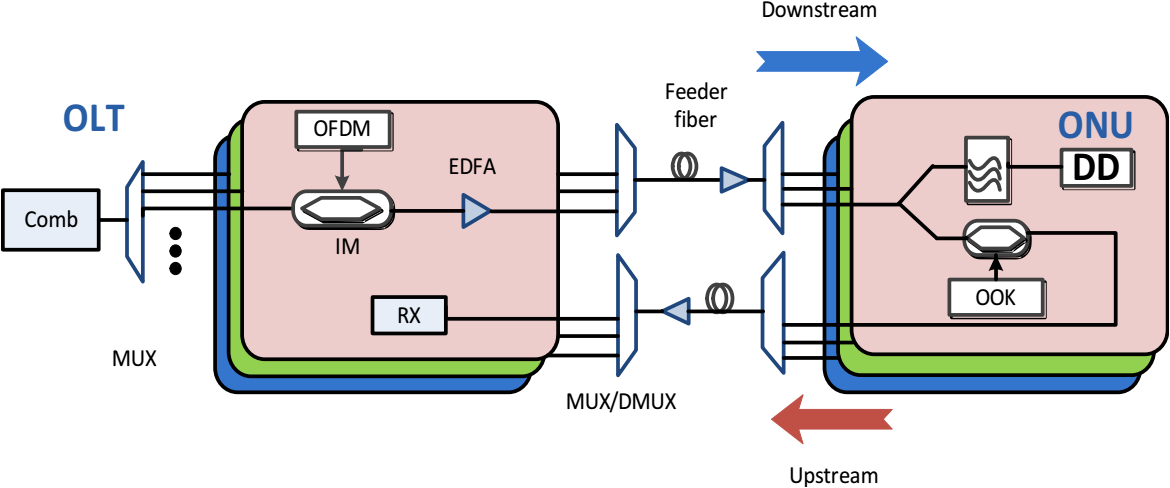
We proposed and demonstrated an ultra-dense optical comb based DWDM-OFDM- PON scheme. At the optical line terminal (OLT), a cost-effective optical frequency comb gen- erator (OFCG) is proposed and achieved as the multi-wavelength optical source. The OFCG is capable to provide multiple channels with reconfigurable wavelength spacing for ultra-dense WDM-PON based access network. In our scheme, OFDM signal with multi-level modulation will be encoded into the OFCG lines for the downstream transmission to enhance the spectral effi- ciency while the OFDM signal will be remodulated by OOK data for the upstream transmission due to its ease of implementation in optical network unit (ONU) side. In experiments, we demon- strated that 10 optical lines with 25 GHz channel spacing are generated and they were modulated by 2.5-GB/s QPSK-OFDM for the downlink signal transmission. We also demonstrated that the multiple wavelengths from the OFCG. The demand bandwidth for end-to-end connectivity of broadband access services is expected to grow tremendous in the coming decades. Dense wavelength multiplexing-passive optical network (DWDM-PON) has been widely investigated for high data rate services [1–3]. In these paper, individual single wavelength laser was employed as continuous wave source providing carrier. The laser array in actual DWDM-PON is costly and unstable in maintaining coherence among multiple optical carriers. Optical frequency comb (OFC) [4–6] provides a alternative for the DWDM system lightwave source. Compared to the individual laser array, OFC generator based DWDM system simplifies the complexity of the system, lower the operation cost and promote the stability [7, 8]. OFC generated by cascading modulators is suitable for communication systems. Although in principle we can anticipate that more modulators can be used together to bring more comb lines, the complexity of the system, high operation cost and large power consumption will hinder the real applications of OFC in communication systems. On the other hand, orthogonal frequency-division multiplexing (OFDM) is considered as a strong candidate for future access network due to its contribution in high spectrum efficiency and resistance to dispersion effects and crosstalk, including inter-channel interference (ICI) and inter-symbol interference (ISI). It is also well known that of the OFDM technology is being widely applied in the fourth generation (4G) and the upcoming fifth generation (5G) mobile communication system thus it will be beneficial to investigate PON system employing OFDM infrastructure for the future seamless integration of wire-and-wireless communication system. In this paper, we proposed an ultra-dense OFC based DWDM-OFDM-PON architecture, as illustrated in Figure 1. At the optical line terminal (OLT), an optical frequency comb generator (OFCG) is employed as the multi-wavelength optical source followed by a wavelength MUX where COMB lines can be divided into individual DWDM channels. Each channel is modulated by an intensity modulator (IM) respectively. In the downstream, quadrature phase shift keying OFDM (QPSK-OFDM) signal is converted to optical domain. An optical multiplexer (MUX) is employed to combine the DWDM channels with signal sent into the 25.6 km single mode fiber (SMF) for downstream transmission. At the optical network unit (ONU) side, direct detection (DD) receiver is adopted taking into account the cost of ONU. For upstream link transmission, the OFDM downstream signal is re-modulated by another intensity modulator at 2.5-Gbit/s OOK format at the ONU and transmitted back to the OLT. In this paper, we proposed an ultra-dense OFC based DWDM-OFDM-PON architecture, as illustrated in Figure 1. At the optical line terminal (OLT), an optical frequency comb generator (OFCG) is employed as the multi-wavelength optical source followed by a wavelength MUX where COMB lines can be divided into individual DWDM channels. Each channel is modulated by an intensity modulator (IM) respectively. In the downstream, quadrature phase shift keying OFDM 700 PIERS Proceedings, Guangzhou, China, August 25–28, 2014 Downstream
Citation
Deming Liu, Jiajia Chen, Zhenhua Feng, Songnian Fu, Rui Lin, Perry Ping Shum, Ming Tang, and Ruoxu Wang, "An Ultra-dense Optical Comb Based DWDM-OFDM-PON System," Proceedings of 2015 Photonics & Electromagnetics Research Symposium, Prague, July 6 - 9,Page(s)699-702
References