Proceedings of 2015 Photonics & Electromagnetics Research Symposium, Prague, July 6 - 9,Page(s)938-940
Abstract
The field rotator is a fascinating device which can be regarded as a special kind of
acoustic illusion, with the capability of making the object covered by it appears like a rotated one.
By exploiting acoustic metamaterials with extremely anisotropic parameters, we have theoreti-
cally designed and experimentally realized an acoustic field rotator that can be employed to rotate
the acoustic wave front by a certain angle. For airborne sound, the designed field rotator sim-
ply comprises an array of identical plates made of acrylonitrile butadiene styrene plastic (ABS).
Both the numerical and experimental demonstrations of the rotation effect illustrate that the
resulting device has a broadband functionality. A nearly perfect agreement is observed between
the numerical simulation and experimental results. The influence of the structural parameters
on its performance has also been investigated. Moreover, we inspect the frequency dependence
of rotation effect and it shows that the designed device can work effectively within a broad band,
as long as the effective medium approximation is valid. In addition, it turns out that by elon-
gating each plate the increase of anisotropy of metamaterial can be conveniently attained, which
contributes to enhance the rotation effect. With the known relationship between the rotated
angle and the structural parameters, the rotation angle can be manipulated conveniently. The
application of the proposed device for non-plane wave has also been discussed and the possibility
of extending the proposed scheme to three-dimensional cases has been considered. With the
capability of rotating acoustic wave front in a controlled manner, the realization of acoustic field
rotator has open up a new avenue for the versatile manipulations on the acoustic waves and may
have potential application in various situations that require special acoustic controls.
Recently, transformation optics [1, 2] as well as transformation acoustics [3] has aroused great
attention. Numerous fantastic devices have been designed and fabricated in experiment, such
as invisibility [4] and illusion cloaks [5], etc.. In this letter, we present the theory design and
experimental realization of an acoustic field rotator, which can rotate the wave front a preset angle
in the center, and it can be regarded as a special acoustic illusion.
We established the mapping between the virtual system and the physical system, and the mass
density ρ−1 in the physical system should be as follows:
µ ¡ ¢ 
1 + 2t cos θ0 sin¡θ0 + t2 sin θ0 ¢ −t2 cos θ0 sin θ0 − t cos2 θ0 − sin2 θ0
ρ−1 = ρ−10 −t2 cos θ0 sin θ0 − t cos2 θ0 − sin2 θ0 1 − 2t cos θ0 sin θ0 + t2 cos θ0
Here the background medium is chosen as air and t = θ0 r/(b − a), which is related to the rotated
angle θ0 in the inner cylinder [6].
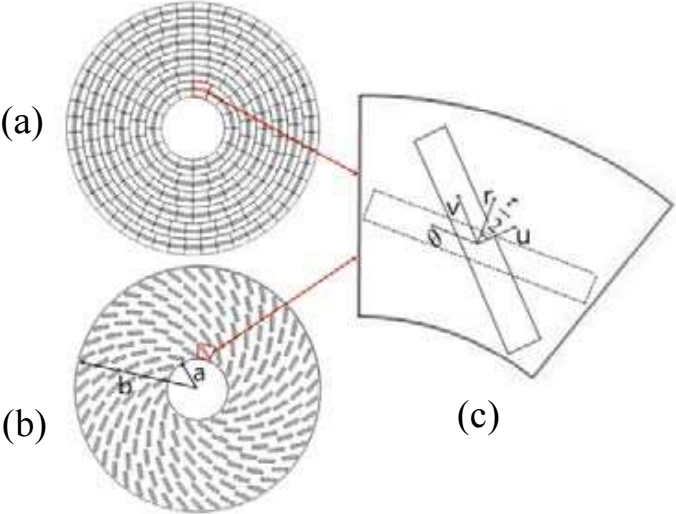
We proposed a reduced model for the implementability in experiment as showed in Fig. 1. The
cylinder is divided into several “fanlike” cells, and a rectangle made of acrylonitrile butadiene
styrene plastic (ABS) is inserted in each cell, with its macro-axis titling an angle τ /2 with respect
to the tangential direction of the cell. The effective mass density in two different directions ρu and
ρv can be obtained.
The experimental scheme is showed in Fig. 2, where an experimental system is established by
two paralleled Plexiglass plates. An array of 188 rectangles was fabricated with thermoplastics
via 3D printing to meet the theoretical requirement. We detected acoustic pressure in the inner
region of the device in three particular frequencies, 3400 Hz, 5700 Hz and 6700 Hz, and compare
the measured results and the simulations as showed in Fig. 3. Throughout the paper, the software
COMSOL MULTIPHYSICS is used for the numerical simulations. It can be clearly observed
that it has an excellent agreement between the experimental result and the simulation under any
particular driving frequency. The wave front inside the rotator remains a plane, almost identical
as the incident wave, and it has been rotated by a certain angle as if the wave is propagating from
the top-left direction.
Next we inspect the frequency dependence of rotation effect. A slice with a nearly negligible
width is placed in the center of the rotator, stretching across the inner circular region. A minimum
Progress In Electromagnetics Research Symposium Proceedings, Guangzhou, China, Aug. 25–28, 2014 939
Citation
Bin Liang,
Jian-Chun Cheng,
and
Xue Jiang,
"Design and Fabrication of Acoustic Rotator Based on Extremely-anisotropic Metamaterials," Proceedings of 2015 Photonics & Electromagnetics Research Symposium, Prague, July 6 - 9,Page(s)938-940