Proceedings of 2015 Photonics & Electromagnetics Research Symposium, Prague, July 6 - 9,Page(s)249-252
Abstract
The electromagnetic field focusing capabilities of non-continuous periodic Mikaelian
lens is considered. Theoretical continuous Mikaelian lens has the electromagnetic field focusing
properties and concentrates incident wave field in one point on the border. Also this lens has
sophisticated structure and cannot be implemented using current technologies. The alternative
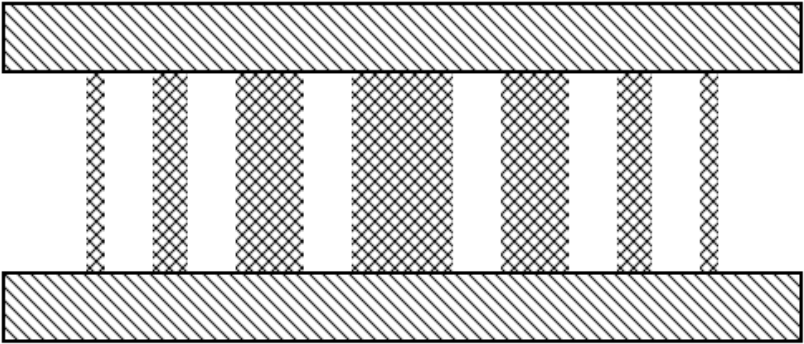
way to implement similar structure is by using periodic layers of constant permittivity which
are separated by the periodic layers of air. The idea is to replace continuous lens with the
another one, which structure could be easily implemented in practice. Continuous lens has
permittivity reducing from 2.56 on the axis of symmetry to 1.0 at the borders. The new lens is a
periodic structure, that does not have the same redundancy of permittivity as the continuous one.
Such lens has layers containing both the non-conductor and the air, and the ratio of thickness
of air to thickness of material increases in the direction from axis of symmetry towards the
borders. Thickness ratio of air to thickness of material in each layer is calculated according to
the permittivity in the continuous lens on the same distance from the axis of symmetry. Material
and air create necessary permittivity in total. It is shown, that the ratio of wavelength to the
one period length should be higher than specific value. FDTD method is used for the numerical
simulation. The thickness of one layer expressed in the number of grid points is important
numerical parameter. When this number is too small, structure of lens close to the axis of
symmetry cannot be resolved, and this leads to loss of focusing capabilities. To avoid this, the
number of grid points per layer should be at least equal to 10, but the higher this number is the
better result would be achieved. The problem with increasing the number is that grid size should
also be increased, and the amount of needed memory will also significantly rise. Number of
computational experiments is performed and electromagnetic-field focusing capability of layered
lens is obtained.
Citation
G. A. Balykov,
Vadim A. Kaloshin,
A. N. Semenov,
and
Aleksander P. Smirnov,
"Electormagnetic Field-focusing EBG Lens," Proceedings of 2015 Photonics & Electromagnetics Research Symposium, Prague, July 6 - 9,Page(s)249-252