PhotonIcs and Electromagnetics Research Symposium,
also known as Progress In Electromagnetics Research Symposium
PIERS Proceedings
Published: 2015-08-28
Analysis and Design of the Switched-beam Antenna Array for Automotive Radar Applications
By
Proceedings of 2015 Photonics & Electromagnetics Research Symposium, Prague, July 6 - 9,Page(s)2561-2564
Abstract
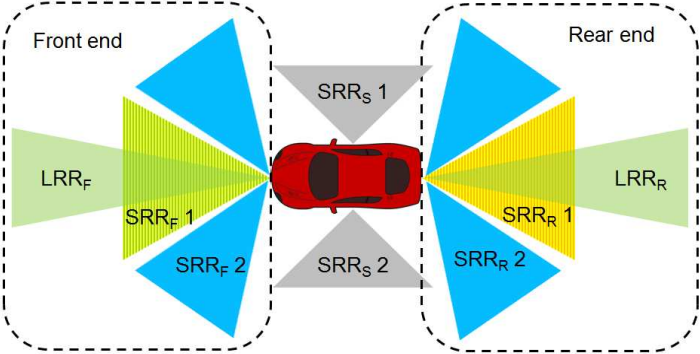
More and more vehicles equip with millimeter-wave radar systems to improve the driving safety. Usually, multiple antenna arrays are used to cover different horizontal field of view (FOV) for most models. Integration is one way to make the automotive radar system more compact and more affordable. A three-mode antenna array is designed to cover narrow (−8◦ to +8◦ ), wide (−45◦ to +45◦ ), and two-direction (−75◦ to −45◦ and from +45◦ to +75◦ ) FOV scenarios. The horizontal FOVs of a typical long-range radar (LRR) and short-range radar (SRR) cover from −8◦ to +8◦ , and from −45◦ to +45◦ , respectively. For the front-end blind side detection, the two-direction FOV covers from −75◦ to −45◦ and from +45◦ to +75◦ , which are often blocked by the vehicle front pillars. Thus, this system can provide a total 150◦ FOV coverage. Based on these FOV requirements, a switch-beam antenna array is proposed, which is based on the minimum variance distortion less response (MVDR) beamforming algorithm. The simulation demonstrates this antenna array can operate not only over the narrow, wide, and two-direction FOV scenarios, but also wide bandwidth (76 to 81 GHz).
Citation
Jau-Jr Lin, "Analysis and Design of the Switched-beam Antenna Array for Automotive Radar Applications," Proceedings of 2015 Photonics & Electromagnetics Research Symposium, Prague, July 6 - 9,Page(s)2561-2564
References