Proceedings of 2015 Photonics & Electromagnetics Research Symposium, Prague, July 6 - 9,Page(s)2331-2335
Abstract
The main parameters displayed by means of magnetic resonance include, for ex-
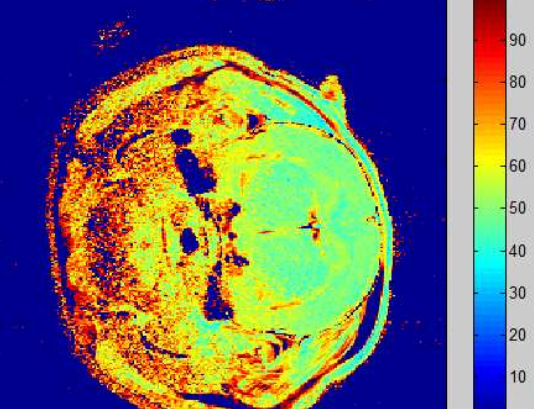
ample, relaxation times T1 and T2 or diffusion parameters. This paper presents the computation
of relaxation time T2 measured indirectly with the Spin Echo method. The sensing coil of the
tomograph provides a signal in which the important factor is the location of the peaks from
individual measurements. These points must be interleaved with an exponential function. The
relaxation time T2 can be directly determined from the exponential shape. The described process
has to be repeated for each pixel of the sensed tissue, and this requirement makes the processing
of larger images very demanding in terms of both the actual computation and the time needed for
the entire operation. More concretely, if we assume the common resolution of 256 × 256, 20 slices,
and five measurements with different times TE , it is necessary to reconstruct 1.3 · 106 exponential
functions in total, which requires the processing of more than 6 MB of data. At present, such
computation lasts approximately 3 minutes if performed by means of a regular PC. The author
discusses various approaches to the parallelization of the given problem. In the described con-
text, the time required for the processing of the applied three-dimensional image was shortened
to 300 ms thanks to simple interpolation approach. The final section of the paper comprises a
detailed comparison of the computation times characterizing both the sequential and the parallel
solutions.
Citation
Pavel Dvorak,
and
Jan Mikulka,
"Fast Calculation of T2 Relaxation Time in Magnetic Resonance Imaging," Proceedings of 2015 Photonics & Electromagnetics Research Symposium, Prague, July 6 - 9,Page(s)2331-2335