PhotonIcs and Electromagnetics Research Symposium,
also known as Progress In Electromagnetics Research Symposium
PIERS Proceedings
Published: 2015-08-28
Using Functional Near-infrared Spectroscopy to Investigate Frontal Cortical Response to Joint/non-joint Attention in Children
By
Proceedings of 2015 Photonics & Electromagnetics Research Symposium, Prague, July 6 - 9,Page(s)2235-2239
Abstract
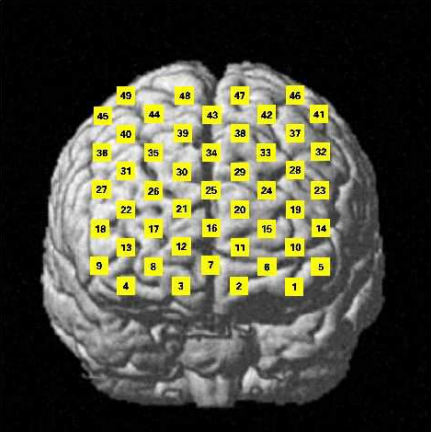
Functional near-infrared spectroscopy (fNIRS) is an optical technique for non- invasively investigating brain functional activity. It measures cerebral hemodynamic parameters that are closely associated with the neural activity. Previous study has demonstrated that indi- viduals with autism are very poor in joint attention skills. In this work, fNIRS was used to access cerebral hemodynamic response to joint and non-joint attention stimuli in children classified as of high and low autistic traits. The stimuli were given by a video that engenders an experience of joint or non-joint attention in observers. 49 channels of oxygenated hemoglobin (HBO) time series were recorded from the frontal cortex when subjects were watching the video. The HBO activation pattern was obtained and the functional connectivity was determined for the two con- ditions. Results show there are significant differences between children with high and low autistic traits, in both the HBO response and the functional connectivity for each condition. Our data suggest that fNIRS may provide imaging-based objective evaluation on autistic traits.
Citation
Jun Li, Huilin Zhu, and Zhifang Zhu, "Using Functional Near-infrared Spectroscopy to Investigate Frontal Cortical Response to Joint/non-joint Attention in Children," Proceedings of 2015 Photonics & Electromagnetics Research Symposium, Prague, July 6 - 9,Page(s)2235-2239
References