Proceedings of 2015 Photonics & Electromagnetics Research Symposium, Prague, July 6 - 9,Page(s)1246-1250
Abstract
Optical brain imaging is emerging as a novel technique for non-invasively investi-
gating functioning brain. It uses near-infrared light to probe human cortex through intact scalp
and skull, providing cerebral hemodynamic information closely associated with neuronal activ-
ity. In addition to investigating various task-related cortical activations, very recently optical
brain imaging has been demonstrated to be able to assess resting state functional connectivity
(RSFC) by recording and cross-correlating the cortical spontaneous fluctuations. In this work,
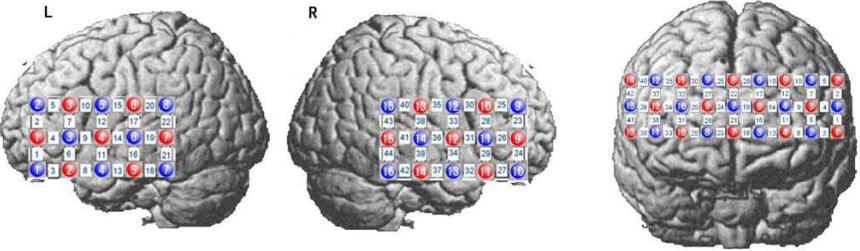
we performed two experiments by using an optical brain imaging system to reveal cortical RSFC.
In Experiment I, the cortical areas measured included bilateral temporal and adjacent inferior
frontal cortices. In experiment II, we measured the prefrontal cortex. The data from Experiment
I show that there are significant differences in the network between children and adults, implying
the developmental differences in the language network. The data from Experiment II show sig-
nificant differences between males and females in prefrontal RSFC, which may be associated with
the underlying physiological basis for sex-related differences in cognitive control and emotional
regulation in humans.
Citation
Jun Li,
and
Lina Qiu,
"Cortical Functional Connectivity Revealed by Optical Brain Imaging," Proceedings of 2015 Photonics & Electromagnetics Research Symposium, Prague, July 6 - 9,Page(s)1246-1250