PhotonIcs and Electromagnetics Research Symposium,
also known as Progress In Electromagnetics Research Symposium
PIERS Proceedings
Published: 2015-08-28
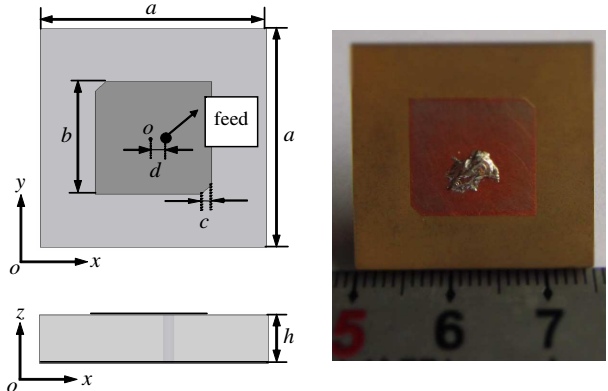
Two Miniaturized Microstrip Patch Antenna for Chinese Compass Navigation Satellite System Based on High-permittivity Substrate
By
Proceedings of 2015 Photonics & Electromagnetics Research Symposium, Prague, July 6 - 9,Page(s)1490-1493
Abstract
With the rapid development of navigation satellite systems, China is accelerating the pace of development of its own Compass Navigation Satellite System (CNSS for short). In CNSS system, miniaturized antennas are more attractive. However, conventional CNSS antennas work at low operation frequency (L band, 1.616±5 MHz and S Band, 2492±5 MHz) which lead to large scale by using low-permittivity ceramic substrate. Consequently, in this paper, we present two miniaturized CNSS microstrip antennas based on high-permittivity (εr = 16) ceramic sub- strate. One is corner-cut-patch structure, and the other is two-pair-slot-patch structure. They work at S Band (2492 ± 5 MHz, right-handed circular polarization, RHCP) to receive position information. An experiment was carried out to verify our design. For corner-cut structure, nu- merical results show that impedance bandwidth (S11 < −10 dB), 3 dB axial ratio bandwidth and gain are about 62 MHz, 15 MHz, and 3.48 dB, and measured results shows that impedance band- width (S11 < −10 dB) and 3 dB axial ratio bandwidth are about 66 MHz, 12 MHz, respectively. Meanwhile, for slot structure, numerical results show that impedance bandwidth (S11 < −10 dB), 3 dB axial ratio bandwidth and gain are about 94 MHz, 23 MHz, and 3.96 dB, and measured re- sults shows that impedance bandwidth (S11 < −10 dB) is about 132 MHz and 3 dB axial ratio bandwidth is much larger than 22 MHz, respectively. Obviously, the characteristics of slot-patch structure are better than the characteristics of corner-cut structure. Measured results fit well with the simulation results. The two antennas can fully meet the requirement of CNSS. Mean- while, comparing with the conventional low-permittivity substrate antennas, the two antennas remain their well performances with a reduced size by 75% to 80%. Such advantages make it proper to practical applications.
Citation
Jiafu Wang, Hua Ma, Shaobo Qu, Mingbao Yan, Hangying Yuan, Jieqiu Zhang, and Lin Zheng, "Two Miniaturized Microstrip Patch Antenna for Chinese Compass Navigation Satellite System Based on High-permittivity Substrate," Proceedings of 2015 Photonics & Electromagnetics Research Symposium, Prague, July 6 - 9,Page(s)1490-1493
References