PhotonIcs and Electromagnetics Research Symposium,
also known as Progress In Electromagnetics Research Symposium
PIERS Proceedings
Published: 2015-08-28
High Stable Exciton Emission from SnO2 Quantum Dots Grown via a Facile ``Top-down'' Strategy
By
Proceedings of 2015 Photonics & Electromagnetics Research Symposium, Prague, July 6 - 9,Page(s)2438-2440
Abstract
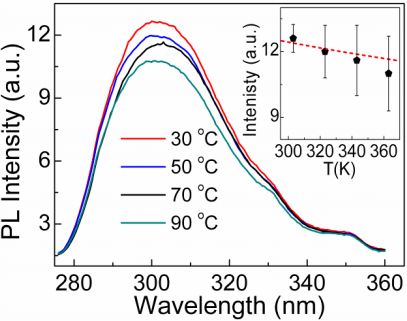
SnO2 is a promising wide band gap semiconductor for next generation ultraviolet (UV) non-polar optoelectronic devices applications. The development of SnO2 -based optoelec- tronic devices is obsessed by its low exciton emission efficiency. In this study, quantum confined SnO2 nanocrystals have been facilely fabricated via pulsed laser ablation in liquid. The intensity of exciton emission from SnO2 quantum dots (QDs) was stable for at least two years. The SnO2 QDs possess high thermal stable exciton emission at 300 nm in water. Therefore, we have shown that SnO2 QDs can be a potential luminescent material suitable for the realization of ultraviolet B non-polar light emitting devices and lasing devices. The research on ultraviolet (UV) light emitting devices is enormously stimulated by the demand of full solid state lightning, integrated photonics, environmental circulation and biomedical diagnos- tics, and et al. [1]. Tin oxide (SnO2 ) is an IV-VI semiconductors with wide direct band gap of 3.6 eV (3.2 eV for ZnO), high exciton binding energy of 130 meV (60 meV or ZnO), and exotic electrical characteristics (e.g., electron mobility: ∼250 cm2 /Vs, concentration: ∼1019 /cm3 ), supreme chemi- cal and physical stability [2, 3]. Moreover, SnO2 and other IV-VI semiconductors have weak ionicity of chemical bond, and the p-type doping, which have greatly obsess the progress of ZnO-based light emitting devices, can be more facilely realized. The SnO2 -based light emitting devices with different structures have been demonstrated [1, 4– 6]. The main difficulty that cumbers the development of SnO2 -based light emitting devices is its weak exciton emission efficiency. Most of the UV luminescence from SnO2 nanowires, films, or single crystal is believed to originate from the defects or unidentified impurities rather than the free exciton emission [7–10]. The valence band and the conduction band of the SnO2 have same parity symmetry, and the dipole transition probability between the conduction and valence band is quite low [11]. As a result, the exciton or band-to-band emission can hardly be obtained in SnO2 films or bulk. For quantum materials, the band structures of semiconductors will be modified due to the quantum confinement effect, and exciton emission is anticipated to be realized in quantum confined SnO2 nanocrystals. At the same time, the intensity of exciton emission will dramatically increase with size decreasing according to the theoretical calculation [12]. In this study, we report on the thermal stability of exciton emission from high quality SnO2 QDs grown by PLAL technique, a “top-down” strategy. The resultant SnO2 QDs exhibit extra-high performance exciton emission properties at ∼300 nm, which may be applied for UV-B QDs light emitting devices. Figure 1(b) indicates the typical photoluminescence (PL) spectra and the thermal stability of SnO2 QDs in water in the wavelength range of 275 nm∼460 nm. There are two emission peaks observed from the PL spectrum of the SnO2 QDs: the dominant exciton emission peak at wave- length of ∼300 nm and weak defects-related emission peak at ∼404 nm. The detailed fabrication process can be found in our previous investigation [13]. The origination of the above two peaks has been demonstrated in our previous report [13]. It should be noted that the room temperature exciton emission intensity increases with storage time interval increasing at ambient temperature or high temperature at 90◦ C in a sealed bottle, as shown in Figure 1(b). There are some defects existed on the surface of as-prepared SnO2 QDs, the crystal quality may be enhanced for long time storage, and defects will decrease after storage. This is consistent with the PL spectrum results, i.e., the ratio of exciton-to-defects intensity gradually increased with storage time. At the same time, the exciton emission peak slightly red shift with storage time increasing, which may be due to the SnO2 QDs particle size grows up during storage. It should be pointed out that the exciton Progress In Electromagnetics Research Symposium Proceedings, Guangzhou, China, Aug. 25–28, 2014 2439
Citation
Shu Sheng Pan, Guanghai Li, Zhao Qin Chu, Wei Lu, Yuan Yuan Luo, Si Chao Xu, and Yun Xia Zhang, "High Stable Exciton Emission from SnO2 Quantum Dots Grown via a Facile ``Top-down'' Strategy," Proceedings of 2015 Photonics & Electromagnetics Research Symposium, Prague, July 6 - 9,Page(s)2438-2440
References