PhotonIcs and Electromagnetics Research Symposium,
also known as Progress In Electromagnetics Research Symposium
PIERS Proceedings
Published: 2015-07-09
LTE Baseband DSP/FPGA for Beamspace MIMO RF Antenna
By
Proceedings of 2015 Photonics & Electromagnetics Research Symposium, Prague, July 6 - 9,Page(s)27-30
Abstract
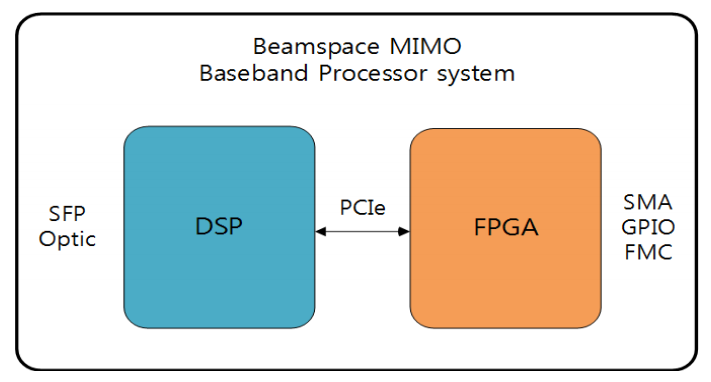
As the MIMO processing gets popular in LTE wireless mobile communication, the number of RF chains of eNodeB for MIMO processing gets increased, which results in the increase of cost and the volume of eNodeB base-station. In order to solve this problem, the Beamspace MIMO RF Antenna has been proposed. The advantage of Beam-space MIMO RF Antenna is to reduce the RF chain which results in the cost reduction of LTE RF module. In order to support Beam-space MIMO RF Antenna, the LTE baseband signal from LTE modem should be transformed. This transformation includes the matrix and trigonometric computation which is complex to be performed by FPGA. From this observation, authors have implemented baseband algorithm in DSP processor which enables the complex matrix computation efficiently. The requirement of DSP processing is 300 Mbps in 33 MHz band which supports 4 streams. While DSP processor is very efficient for the matrix computation, there should be interface module between baseband DSP and the impedance loading module for Beam-space MIMO RF Antenna. Authors have implemented this interface module with FPGA. The interface between DSP processor and FPGA has been implemented PCIe (PCI Express) to support high-speed serial IO. The integration system has been designed with LTE modem that supports 4 × 4 MIMO. The testing of full integration system consists of baseband DSP, FPGA, LTE modem and Beam-space MIMO RF Antenna module. Various spectrum analyzers have been used to validate the design of Beamspace MIMO RF baseband system during the test procedure.
Citation
Dang-Oh Kim, and Uooyeol Yoon, "LTE Baseband DSP/FPGA for Beamspace MIMO RF Antenna," Proceedings of 2015 Photonics & Electromagnetics Research Symposium, Prague, July 6 - 9,Page(s)27-30
References

1. Kalis, A., A. G. Kanatas and C. B. Papadias, Parasitic Antenna Arrays for Wireless MIMO Systems, 978-1-4614-7998-7. Ed., Springer, New York; Heidelberg; Dordrecht; London, 2014.
doi:10.1007/978-1-4614-7999-4_2        Google Scholar

2. Hong, Seung-Eun and Kyoung-Sub Oh, "Load-Modulated Single-RF MIMO Transmission for Spatially Multiplexed QAM Signals," 2015 IEEE 81st Vehicular Technology Conference (VTC Spring), 1–6, May 2015.
doi:10.1109/vtcspring.2015.7145915        Google Scholar

3. Han, Bo, Vlasis I. Barousis, Constantinos B. Papadias, Antonis Kalis, and Ramjee Prasad, "MIMO over ESPAR with 16-QAM Modulation," IEEE Wireless Communications Letters, Vol. 2, No. 6, 687–690, December 2013.
doi:10.1109/wcl.2013.092813.130433        Google Scholar

4. Muller, Ralf R., Mohammad A. Sedaghat, and Georg Fischer, "Load modulated massive MIMO," 2014 IEEE Global Conference on Signal and Information Processing (GlobalSIP), 622–626, December 2014.
doi:10.1109/globalsip.2014.7032192        Google Scholar

5. Sedaghat, M.R. Muller and G. Fisher, Proc. ITG Workshop on Smart Antennas, 1-8, 2014.        Google Scholar