PhotonIcs and Electromagnetics Research Symposium,
also known as Progress In Electromagnetics Research Symposium
PIERS Proceedings
Published: 2015-07-09
A 16-Element Wideband Microwave Applicator for Breast Cancer Detection Using Thermoacoustic Imaging
By
Proceedings of 2015 Photonics & Electromagnetics Research Symposium, Prague, July 6 - 9,Page(s)243-247
Abstract
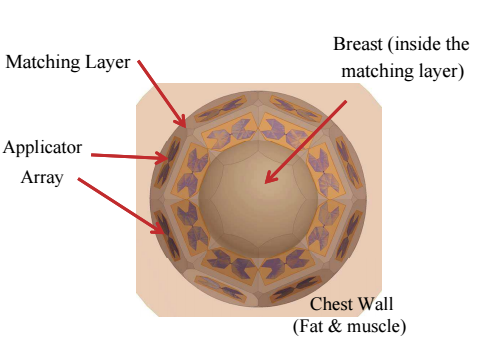
Microwave-induced thermoacoustic (TA) imaging is a hybrid technique that com- bines the high dielectric contrast of microwave imaging with the high resolution of ultrasound detection. This technique can achieve a penetration depth in excess of 5 cm, even in dispersive tissue. With all these capabilities, TA imaging is a suitable method for breast cancer screening, which requires a high contrast between cancer and benign tissues, and millimeter-level resolution. The most popular way to excite the imaging target is to employ a waveguide, which is limited in bandwidth and usually not well matched to the target for TA imaging. In this paper, a wide- band and compact microwave applicator, which can efficiently excite the tissue in the near and quasi-near field range, is designed. A 16-element conformal phased array based on the proposed applicator focuses the microwave energy and controls the location of high specific absorption rate (SAR) region by tuning the phase of array elements. This architecture increases local SAR of the focus area and directly results in a higher signal-to-noise ratio (SNR) of the target region in the reconstructed image compared to uniform excitation. Full-wave electromagnetic simulations demonstrate the ability to localize and control the high SAR region across the target in the entire bandwidth.
Citation
Hao Nan, Amin Arbabian, Nemat Dolatsha, and Shiyu Liu, "A 16-Element Wideband Microwave Applicator for Breast Cancer Detection Using Thermoacoustic Imaging," Proceedings of 2015 Photonics & Electromagnetics Research Symposium, Prague, July 6 - 9,Page(s)243-247
References