Published: 2015-08-28
Contribution of Evanescent Waves to Vortex Vector Field with Inhomogeneous Polarization in Near Field
Proceedings of 2015 Photonics & Electromagnetics Research Symposium, Prague, July 6 - 9,Page(s)79-81
Abstract
We study the evanescent wave of a vortex vector optical field with inhomogeneous
states of polarization in the cross section of the field. The TE and TM terms of the evanescent
wave and the propagating wave of a cylindrical vortex vector optical field with inhomogeneous
states of polarization in the cross section of the field are derived by the vector angular spectrum
method. The vector structure of the evanescent wave and propagating wave components of the
cylindrical vector field is demonstrated. The ratio of the evanescent wave and the propagating
wave of a cylindrical vector optical field with different states of polarization with different vor-
tex charges n and polarization charges m as a function of propagation distance in near field is
described. Comparison between the contribution of TE and TM terms of both the propagating
and the evanescent waves of the cylindrical vortex vector field in free space is demonstrated.
The intensity (squared modulus) distributions of the TE and TM terms of the propagating and
evanescent waves are described to compare the contributions of the propagating and the evanes-
cent waves associated with the cylindrical vector field with inhomogeneous states of polarization
in the cross section of the field. These results, therefore, provide useful information on how to
spatially manipulate the evanescent waves of a vortex vector cylindrical optical field in near field
by choosing appropriate vortex charges n and states of polarization in the cross-section of the
field.
Recently, the vector optical field with the different states of polarization in the cross-section of
the field has attracted much interest in linear and nonlinear optics realms due to its novel properties
and potential application [1, 2]. In the Cartesian coordinate system, the z-axis is taken to be the
propagation axis. A cylindrical optical vector field is expressed as [1, 2]
E(r, θ) = A(r, θ)[cos(mθ + θ0 )ex + exp(i∆θ) sin(mθ + θ0 )ey ], (1)
p
where r = x2 + y 2 and θ = arctan(y/x) are the polar radius and azimuthal angle in the polar
coordinate system, respectively. m is the topological charge, and θ0 is the initial phase. ex and ey
are the unit vectors in x and y-direction, respectively. m is the topological charge, and θ0 is the
initial phase. ex , ey and ez are the unit vectors in x, y and z-direction, respectively. When m = 1
with θ0 = 0 and π/2, the vector fields describe the radially and azimuthally polarized vector fields,
respectively. When m = 0, Eq. (1) degenerate to the linearly-polarized fields. A(r) represents the
amplitude distribution in the cross-section of the cylindrical vector field. For the case with ∆θ 6= 0
(Eq. (1)), however, the x- and y-components have different phase, indicating a hybrid-polarized
vector field with the linear, circular and elliptical polarization states located at different position
in the field cross-section.
For the Gaussian distribution with the n-th vortex and an arbitrary polarized electromagnetic
field (see Eq. (1)) in the source plane z = 0, A(r, θ) = exp(−r2 /w2 ) exp(inθ) where w is beam-width.
By using the Fourier transform, the angular spectrum is
A(ρ cos φ, ρ sin φ) = Q {P exp[i(mφ + nφ + θ0 )](ex − i exp(i∆θ)ey )
+T exp [−i (mφ − nφ + θ0 )] (ex + i exp(i∆θ)ey )
− [P exp[i(mφ + nφ + θ0 )] (cos φ − i exp(i∆θ) sin φ)
+ T exp [−i (mφ − nφ + θ0 )] (cos φ + i exp(i∆θ) sin φ)] ρ/γez } (2)
with
¡ ¢ ¡ ¢
P = I(m+n−1)/2 k 2 w2 ρ2 /8 − I(m+n+1)/2 k 2 w2 ρ2 /8
¡ ¢ ¡ ¢
T = I(m−n−1)/2 k 2 w2 ρ2 /8 − I(m−n+1)/2 k 2 w2 ρ2 /8
µ ¶2 √
m+n k πkw3 ρ
Q = πi exp(−k 2 w2 ρ2 /8)
2π 8
�80 PIERS Proceedings, Guangzhou, China, August 25–28, 2014
where k is the wavenumber I(·) are the Bessel functions of the second kind and ez is the unit vector
in z direction. The electric field component of the vector cylindrical optical field in z plane can be
represented as
3 3 √π Z ∞
m+n k w k 2 w 2 ρ2
E(r) = (−1) e− 8 {P Jm+n (−krρ) exp[i(mθ + nθ + θ0 )](ex − i exp(i∆θ)ey )
16 0
+T Jm−n (−krρ) exp[−i(mθ − nθ + θ0 )](ex + i exp(i∆θ)ey )
+[P Jm+n+1 (−krρ) exp[i(mθ + nθ + θ + θ0 )](1 − exp(i∆θ))
+P Jm+n−1 (−krρ) exp[i(mθ + nθ − θ + θ0 )](1 + exp(i∆θ)))
+T Jm−n−1 (−krρ) exp[−i(mθ − nθ − θ + θ0 )](1 + exp(i∆θ))
+T Jm−n+1 (−krρ) exp[−i(mθ − nθ + θ + θ0 )](1 − exp(i∆θ)) ]iρ/2γez } × exp (ikγz) ρ2 dρ (3)
In order to compare the contributions of the propagating and the evanescent waves associated
with the cylindrical vector field, the integrated intensity (squared modulus) of the propagating and
evanescent fields, Ipr and Iev , are calculated respectively [3, 4]:
ZZ Z 1 Z 2π h i
2
Ipr = |Epr | dxdy = |a|2 + |b|2 ρdρdφ, (4)
0 0
ZZ Z ∞ Z 2π h i p
Iev = |Eev |2 dxdy = |a|2 + |bev |2 exp(−2kz ρ2 − 1)ρdρdφ, (5)
1 0
with
a = A(ρ, φ) · e1 b = A(ρ, φ) · e2 bev = A(ρ, φ) · eev ,
For m = 1,
Z 1 £¡ ¢¡ ¢ ¤ ¡ ¢
Ipr = 2π |Q|2 P2 + T2 2 − ρ2 + 2ρ2 P T cos2 (∆θ/2) cos (2θ0 ) / 1 − ρ2 ρdρ (6)
Z ∞£¡ 2 ¢¡ ¢ ¡ ¢ ¤
Iev = 2π |Q|2
P + T 2 2 − 3ρ2 + 2ρ4 + 2 3ρ2 − 2ρ4 P T cos2 (∆θ/2) cos (2θ0 )
1
³ p ´
exp −2kz ρ2 − 1 ρ
dρ (7)
1 − 3ρ2 + 2ρ4
For m > 1,
Z 1
¡ ¢¡ ¢ ¡ ¢
Ipr = 2π |Q|2 [ P 2 + T 2 2 − ρ2 ]/ 1 − ρ2 ρdρ (8)
¡ ¢ ³ p ´
Z ∞ 2 − 3ρ2 + 2ρ4 exp −2kz ρ2 − 1
¡ ¢
Iev = 2π |Q|2 P 2 + T 2 ρdρ (9)
1 1 − 3ρ2 + 2ρ4
The substitution of Eqs. (4)–(7) into Eqs. (8) and (9), and performing integration over Ø from
zero to 2π yield a single integration of ρ. Then, the corresponding results can be obtained by
performing numerical integration over ρ. The ratio δ = (Ipr − Iev )/Ipr provides direct information
about the propagating and evanescent components of the field.
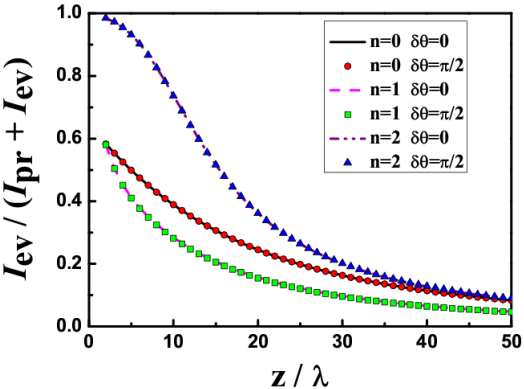
The ratio δ = (Ipr − Iev )/Ipr for w = 0.1λ (highly non-paraxial case) and w = 0.5λ cases
as a function of different distances z from the initial plane z = 0 are shown in the Fig. 1. The
evanescent field dominates near the source plane and the relative weight of Iev would drastically
decrease with the increasing propagation distance. Thus it can be negligible in the propagation
distance z = 0.5λ as shown in Fig. 1. Comparing Figs. 1(a) with (b), one can recognize that
the relative weight of Iev would reduce when the waist size w increases. i.e., the relative weight
of the evanescent wave component is increasing with increasing non-paraxial as the waist size w
decreases. The relative weight of Iev would increase with the increasing topological charge. It
can be explained that the field distribution will increasingly diverge and extend from the center
of beam with the increasing topological charge. As a result, the relative weight of Iev would
increase with the increasing topological charge under the same conditions and beam parameters.
�Progress In Electromagnetics Research Symposium Proceedings, Guangzhou, China, Aug. 25–28, 2014 81
Citation
Rui Pin Chen,
and
Yin-Long Feng,
"Contribution of Evanescent Waves to Vortex Vector Field with Inhomogeneous Polarization in Near Field,"
Proceedings of 2015 Photonics & Electromagnetics Research Symposium, Prague, July 6 - 9,Page(s)79-81
 Suzhou2026