Proceedings of 2015 Photonics & Electromagnetics Research Symposium, Prague, July 6 - 9,Page(s)1178-1181
Abstract
Compact blocking layers made of wide band gap semiconductors, such as TiO2 ,
ZnO, are widely used to suppress recombination at the conductive FTO substrate/electrolyte
interface in dye or quantum dot sensitized solar cells, especially in the solid-state devices. Though
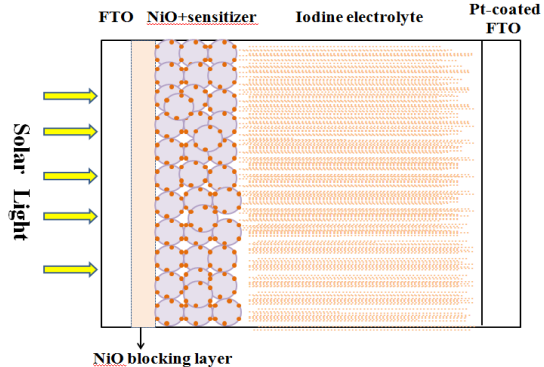
sharing similar mechanism, blocking layers in p-type sensitized solar cells are rarely studied. Our
recent works have demonstrated that the compact NiO films dependent upon the preparation
ways play important roles in both p-type dye and quantum dots sensitized solar cells. In p-type
dye sensitized NiO solar cell, the compact NiO layer prepared by spin-coating of a sol-gel film,
can prevent the recombination at the FTO glass/electrolyte interface and retard the whole cell’s
recombination kinetics. Therefore, the fill factor and photovoltage can be increased, leading to
a 40.77% improved performance of p-type solar cell. In p-type organometal halide perovskite
sensitized mesoporous NiO solar cell, it is found that only the spray pyrolysis deposited NiO
dense film is effective for selective hole gathering, rather not the sol-gel deposited NiO dense film.
The difference may be ascribed to their coverage status on the rough FTO glasses. The existence
of such a NiO block layer not only effects on the cell performance but also determines the current
flow direction in the p-type perovskite sensitized NiO solar cell.
Citation
Wei Chen,
Huan Wang,
Xianwei Zeng,
and
Wenjun Zhang,
"The Roles of Different NiO Compact Blocking Layers in P-type Sensitized Solar Cells," Proceedings of 2015 Photonics & Electromagnetics Research Symposium, Prague, July 6 - 9,Page(s)1178-1181