Proceedings of 2015 Photonics & Electromagnetics Research Symposium, Prague, July 6 - 9,Page(s)449-453
Abstract
The Interferometry Synthetic Aperture Imaging Radiometers (SAIRs) is to sam-
ple visibility function based on the Nyquist theory of space interferometry measurement, which
do not need the mechanical scanning and can directly image. Due to the complex structure
of the imaging system and low imaging resolution, the SAIRs practical application is limited
seriously. According to the characteristic of the image is sparse or can be sparse representation
in transform domain, the Compressed Sensing (CS) can project the high-dimensional signal to
low-dimensional space, so the quantity of the projection measurement data is far less than that
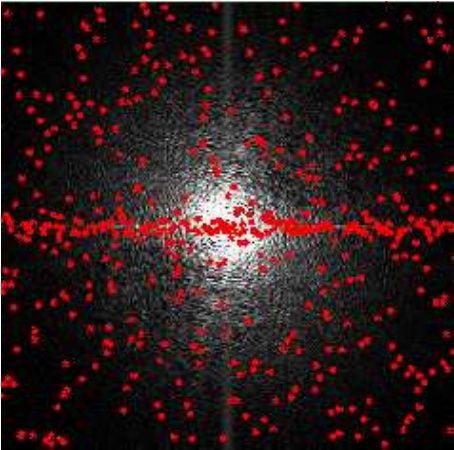
by the Nyquist sampling method. Also the microwave radiation interferometry conducted in
the frequency domain, which has the characteristics of low frequency information less and high
frequency information richer, and the distribution of them is centralized; at the same time, the
microwave radiation image itself have the specialty of the gradient sparsity and the local smooth-
ness, it can be sparse representation in differential domain. On the basis of the priori information
about the observation and the sparse domain, we establish the incoherent optimization model be-
tween the observation matrix and the sparse matrix according to the principle of the two matrixes
satisfying the irrelevant in the CS. Using the incoherent optimization model, we can adaptively
obtain the spatial measurement with different probability, to realize super sparse interferometry.
The adaptive super-sparse sampling method can overcome the disadvantage of equal probability
of the Fourier random sampling methods. In order to reconstruct the microwave radiation image,
we establish the imaging model based on total variation regularization constraint, and use the
alternating iterative algorithm to realize the reconstruction. The simulation and experiment re-
sults show that it is fast to reconstruct microwave radiation image with the adaptive super-sparse
sampling method, and it can greatly improve the quality of the microwave radiation image in the
case of the same sampling rate.
Citation
Suhua Chen,
Yuanyuan Liu,
and
Lu Zhu,
"A Microwave Radiation Interferometry Method Based on Adaptive Super-sparse Sampling," Proceedings of 2015 Photonics & Electromagnetics Research Symposium, Prague, July 6 - 9,Page(s)449-453