Proceedings of 2015 Photonics & Electromagnetics Research Symposium, Prague, July 6 - 9,Page(s)963-965
Abstract
The THz gap has attracted considerable interest in the last decade in a wide range
of applications (from astronomy to biology) due to the low energy of the THz waves and their
capability to provide chemical recognition and non-destructive inspection. To implement THz-
based solutions, a wide range of components have been developed and efforts are being done to
reduce the system cost through the use of cost effective materials.
This presentation analyzes the development of metal wire grids by using the conductive properties
of graphite. The aim is drawing the wire grid using a simple graphite lead pencil on standard
paper. This would reduce the cost of several wire grid base components, such as polarizers or
filters.
An 8B pencil is used because of its high graphite contents. Parameters such as the pitch of the
structure and its fill factor are set to study the behavior of the metal grid in a frequency range
from 0.1 to 0.7 THz. An average pitch of 800 micrometers with a fill factor of 0.8 corresponds
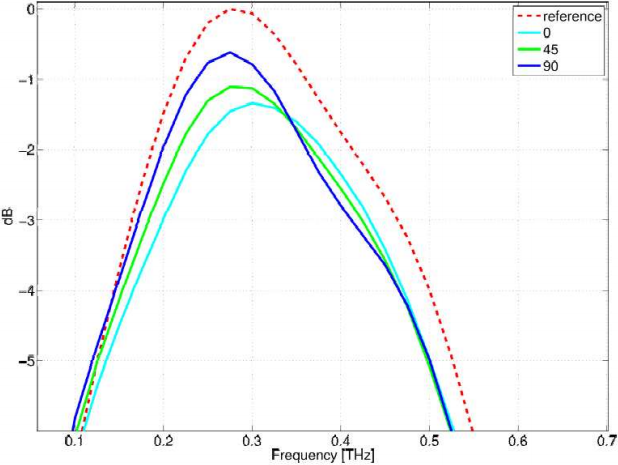
to an ER of 2 dB. The samples are analyzed using a fiber-based pulsed THz Time Domain
Spectrometer in transmission mode. An ultrafast laser pulse impinges on a photoconductive
antenna generating the THz beam that is detected by a similar switch. Preliminary experimental
results show that the increase of the angle between the horizontally-polarized incoming electric
field and the graphite periodic structure corresponds to a decrease of the THz absorption, hinting
at a polarizer behavior.
Citation
Borja Vidal Rodriguez,
and
Margherita Patrizia Maria Colleoni,
"Experimental Analysis of Thin Graphite Periodic Structures in the THz Band," Proceedings of 2015 Photonics & Electromagnetics Research Symposium, Prague, July 6 - 9,Page(s)963-965