PhotonIcs and Electromagnetics Research Symposium,
also known as Progress In Electromagnetics Research Symposium
PIERS Proceedings
Published: 2015-08-28
A PolSAR Classification Method Based on Scattering Model and Polarization Correlation Coefficient
By
Proceedings of 2015 Photonics & Electromagnetics Research Symposium, Prague, July 6 - 9,Page(s)1420-1424
Abstract
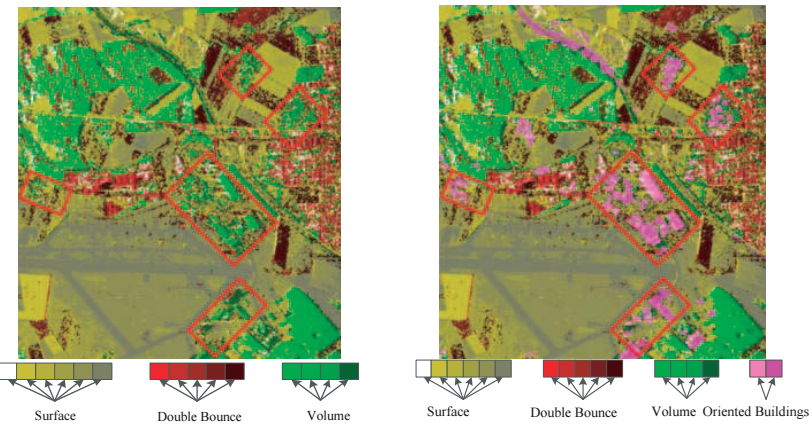
Recently, many PolSAR image classification methods have been proposed. One commonly used method is based on the scattering model. However, traditional classification based on scattering model usually overestimates the volume scattering contributions, especially in urban areas, resulting in buildings not orthogonal to radar Line-Of-Sight (LOS) misjudged as forests. To solve this problem, an improved PolSAR classification method based on scattering model and polarization correlation coefficient is presented in this paper. By introducing two types of polarization correlation coefficients, circular-pol correlation coefficient (CCC) and normalized circular-pol correlation coefficient (NCCC), the oriented buildings can be effectively extracted from the volume scattering. Since the amplitude values of CCC of forests are very small, while that of buildings orthogonal to radar LOS or with small orientation angles are close to 1. There- fore, the CCC parameter is firstly used to extract some slightly tilted oriented buildings form the initial volume scattering category. Then, the NCCC parameter is introduced to distinguish the buildings with large orientation angles from the remainder volume scattering components. Since these buildings hold strong non-reflection symmetry and larger orientation angles, the val- ues of NCCC of this kind are much larger than that of forests. Finally, the extracted buildings are reclassified into a new oriented buildings category. In order to maintain the dominant scat- tering mechanism characteristics, the classification method preserving scattering characteristics is utilized to classify the corrected scattering categories. The proposed classification algorithm remedies the defect of traditional scattering-model-based classification method and the experi- ment result of an E-SAR L-band PolSAR image of Oberpfaffenhofen, Germany demonstrates the effectiveness of the proposed method.
Citation
Jianbo Wang, Chao Wang, Fan Wu, Hong Zhang, and Bo Zhang, "A PolSAR Classification Method Based on Scattering Model and Polarization Correlation Coefficient," Proceedings of 2015 Photonics & Electromagnetics Research Symposium, Prague, July 6 - 9,Page(s)1420-1424
References