PhotonIcs and Electromagnetics Research Symposium,
also known as Progress In Electromagnetics Research Symposium
PIERS Proceedings
Published: 2015-08-28
Broadband Analysis and Characterization of Noise for In-door Power-line Communication Channels
By
Proceedings of 2015 Photonics & Electromagnetics Research Symposium, Prague, July 6 - 9,Page(s)719-723
Abstract
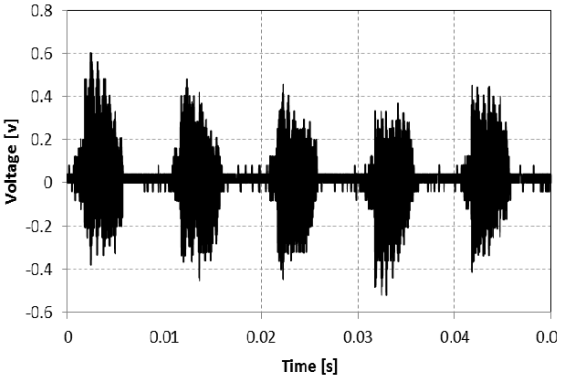
Powerline communication (PLC) has emerged as an alternative solution for con- nectivity at home and offices in recent times [1]. Its development for multimedia broadband applications thus requires an extensive knowledge of the major peculiarities which influences communication over this channel. PLC channels are susceptible to noise inherent in power net- works, leading to performance degradation. In this work, we have set-up a measurement system designed to capture the noise both in frequency and time domain for real power networks. The main observable components of the indoor PLC noise are: background noise, impulsive noise, and narrowband interferences. The impulsive components of PLC noise are observed to be time variant, random in nature, have high power spectral density (PSD) and lasts for very small time durations. A greater portion of the impulsive noise has cyclostationary behaviour, though with different amplitudes and widths. The repetition rates of these impulses are synchronous with the mains harmonics of 50 Hz and 100 Hz, the supply frequency in South Africa. Others have irregular occurrences and much higher repetition rates; hence they are unpredictable in nature. This noise is referred to as asynchronous impulsive noise [2]. These noise terms are key design parameters for modulation schemes in broadband PLC, popu- larly orthogonal frequency division multiplexing (OFDM), with its conventional receivers assum- ing additive white Gaussian noise (AWGN) [3]. The time variability of PLC noise is presented alongside its statistical analysis based on a series of measurements performed on numerous power- line scenarios. The relevance of this time variance is evaluated in actual channels. The significant difference in amplitudes of the impulsive noise is observed and characterized statistically. The PSD for both the background and impulsive noise is presented. Finally, we present the results of the noise PSD captured with a parametric model and compare our results with findings from other parts of the world.
Citation
Thomas Joachim Odhiambo Afullo, and Modisa Mosalaosi, "Broadband Analysis and Characterization of Noise for In-door Power-line Communication Channels," Proceedings of 2015 Photonics & Electromagnetics Research Symposium, Prague, July 6 - 9,Page(s)719-723
References