Proceedings of 2015 Photonics & Electromagnetics Research Symposium, Prague, July 6 - 9,Page(s)1795-1798
Abstract
Photonic crystal (PhC) cavities have drawn plenty of attentions during the past
several decades for the advantages of ultra-high Q factor and small mode volume. PhC cav-
ities have various applications such as quantum information processing, low threshold lasers,
optomechanics, and nonlinear optics. PhC cavities based on silicon material have been heavily
investigated due to their compatibility with complementary metal-oxide-semiconductor (CMOS)
technology, small feature size and low cost. However, apart from the advantage of high Q factor,
silicon based PhC cavities suffer from the drawbacks of high insertion loss because of the mode
mismatch with fiber and relatively low sensitivity especially for the sensing application. On the
other hand, silicon dioxide (silica) waveguide experience relatively smaller loss and owns a similar
refractive index to numerous liquid materials to be detected, which will leads to high sensitivity
for a silica based PhC cavity sensor. In this paper, we propose a high Q factor (Q = 15500)
silica based PhC nanobeam cavity with high sensitivity (the wavelength shift per refractive in-
dex unit (RIU) is S = 338 nm/RIU) at the telecommunication wavelength (1550 nm). Since the
refractive index contrast for silica waveguide is low for the realization of the photonic bandgaps,
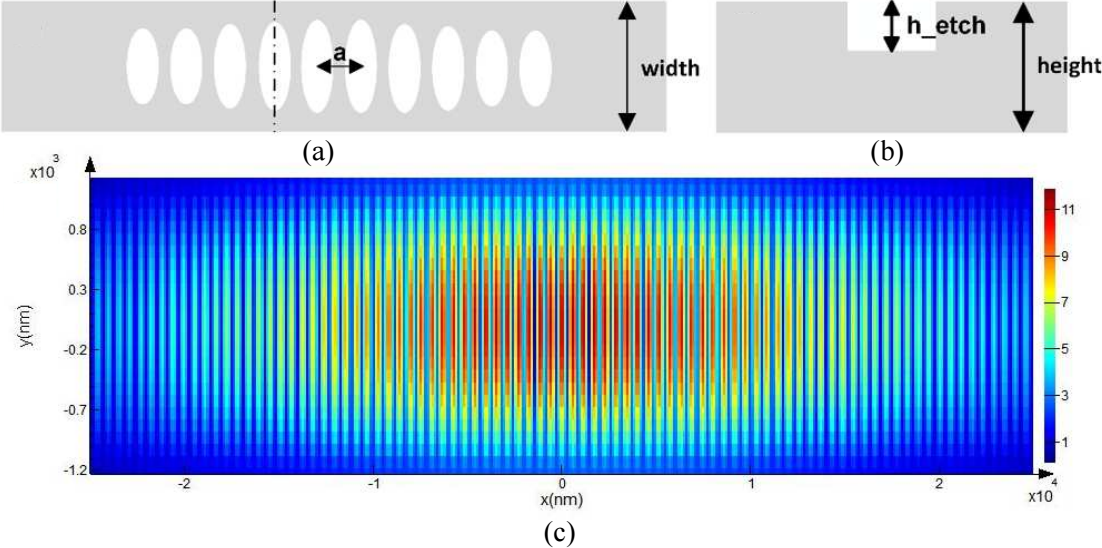
it is essential to utilize a silica waveguide suspended in free space. The PhC nanobeam cavity
is then formed by etching a series of elliptical holes, whose dimensions linearly decrease from
the center to both ends, directly into the silica waveguide. For the sake of high transmission
on-resonance wavelength while maintaining high Q factor, it’s important to etch partly into
the waveguide, which results in a low-refractive-index perturbation structure. The calculated
on-resonance transmission is about 0.26. The novel proposed PhC nanobeam cavity shows a
sensitivity 3 times larger than the one based on silicon counterparts and outperforms other low-
index-contrast PhC cavities by a higher on-resonance transmission. Such a structure can also be
used in spectrally filtering system and nonlinear optics.
Citation
Sailing He,
and
Senlin Zhang,
"High-Q Weakly Modulated Nanobeam Cavity Based on a Suspended Silicon Dioxide Waveguide," Proceedings of 2015 Photonics & Electromagnetics Research Symposium, Prague, July 6 - 9,Page(s)1795-1798