Proceedings of 2015 Photonics & Electromagnetics Research Symposium, Prague, July 6 - 9,Page(s)1907-1910
Abstract
Nuclear quadrupole resonant spectroscopy is method similar to nuclear magnetic
resonant spectroscopy also called zero field NMR [1, 2]. The response signal magnitude is very low
and it is immersed in to the noise. There can be used some methods to harvest signal from noise it
can be matched receiver [3] or averaging. This authors describe detector for Nuclear quadrupole
resonant spectroscopy based on statistic methods and probability of distribution, that allow to
measure repetitive signals below noise level. The paper presents the mathematical model and
practical solution of the detector, and problems such as the dynamic range and signal distortion
based on the signal-to-noise ratio are also analyzed in the given context. If the time of signal
occurrence is known, the repetitive signal below the noise level can be harvested out of noise by
averaging because of the wanted signal is correlated therefor highlighted by averaging contrast to
the noise which is not correlated so it is supressed by averaging. The same principle we can use
in domain of digital signal. So the input signal can be converted to the digital representation.
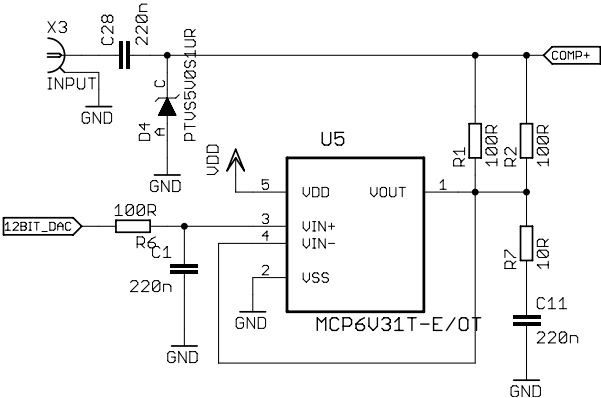
There is an comparator with a triggering level immersed in the noise so the comparator is flipping
continuously and the probability of output values is affected by input signal. The output digital
signal can be processed by FPGA.
Citation
Jiri Chytil,
and
Radek Kubasek,
"Detector for Nuclear Quadrupole Resonance Spectroscopy," Proceedings of 2015 Photonics & Electromagnetics Research Symposium, Prague, July 6 - 9,Page(s)1907-1910