Proceedings of 2015 Photonics & Electromagnetics Research Symposium, Prague, July 6 - 9,Page(s)2365-2368
Abstract
All fields and potentials in space have energy. The gravitational field and potential
are no exceptions. Such energy is a ‘super-liquid’ having a non-particulate continuous distri-
bution. It is not quantised. Field energy is thus defined as ‘dark matter’. Any ‘dark’ matter
has gravitational mass density proportional to energy density according to E = mc2 . But dark
matter has low inertia. Its inertial mass is deduced to be < 1/(2π)2 =∼ 1/40 of its gravitational
mass. The gravitational potentials from any two or more objects combine at any point according
to newly discovered RSS (Root-Sum-of-the-Squares) ‘process capture’ rules. This means that
the stronger potential partially ‘suppresses’ the weaker potential. The weaker energy is thus
partially suppressed and becomes ‘excluded’ in the region of stronger energy density from a dom-
inant source. Total energy is reduced and gravitational attraction is thereby created. The ‘lost’
energy increases according to the inverse square law of two sources. This is the source of gravita-
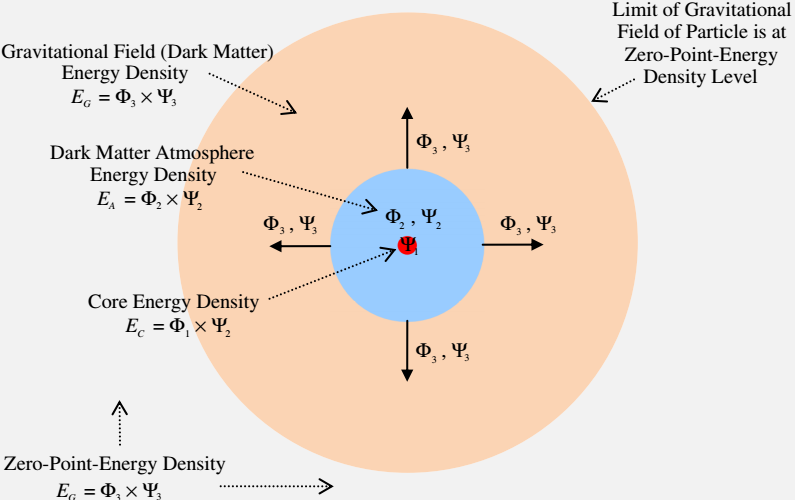
tional attraction of sources and masses. The gravitational field of a light particle terminates at a
finite distance when it drops below the Zero-Point-Energy density of free space. These rules can
be shown to apply both to gravity and to electromagnetic energy of any spectral distribution.
Gravity and Electromagnetism thus become ‘unified’.
Citation
Michael James Underhill,
"A Dark Matter Model to Unify Gravity and Electromagnetism," Proceedings of 2015 Photonics & Electromagnetics Research Symposium, Prague, July 6 - 9,Page(s)2365-2368