Proceedings of 2015 Photonics & Electromagnetics Research Symposium, Prague, July 6 - 9,Page(s)266-270
Abstract
This paper introduces a method of IC-level Electrostatic Discharge (ESD) testing
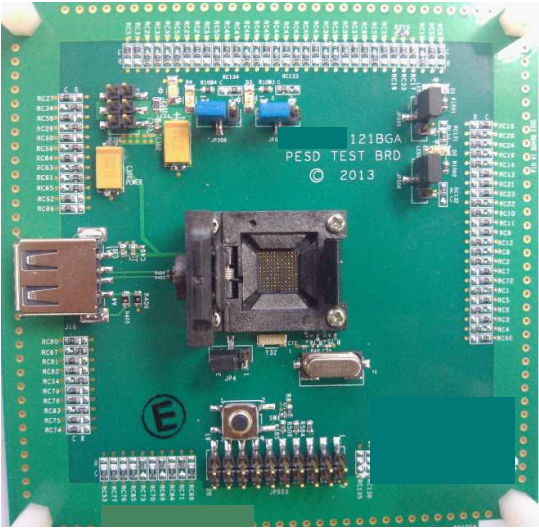
and discusses the influence of the socket on Chip-Level ESD testing. During the powered ESD
(PESD) testing, welding the chip to the PCB is a necessary process which can be a repetitive
process and time consuming. In order to solve this problem, a ball grid array (BGA) test socket is
used during the test. The socket is built from copper-clad pogo pin and is pinned in an 8 × 8 mm
array with 121 pins on a 0.65-mm pitch. As the test results suggest, there is little difference
between testing with the socket and without. So in this study we take such factors into account
as the pan angle range between ESD gun and PCB, the ESD gun, etc.. It is found in this study
that the difference value (D-value) percentage between socketed ESD testing and non-socketed
ESD testing is within 6.4%, the D-value percentage that the pan angle range of the ESD gun
produces is within 5.8%, and the D-value percentage that the ESD GUN produces is within 5.8%.
Based on these findings, it is concluded that work efficiency can be greatly improved by using
the socket in PESD testing.
Citation
Jiancheng Li,
Jianwei Su,
Jianfei Wu,
Yu Xiao,
and
Yunzhi Kang,
"Influence of the Socket on Chip-level ESD Testing," Proceedings of 2015 Photonics & Electromagnetics Research Symposium, Prague, July 6 - 9,Page(s)266-270