Proceedings of 2015 Photonics & Electromagnetics Research Symposium, Prague, July 6 - 9,Page(s)400-402
Abstract
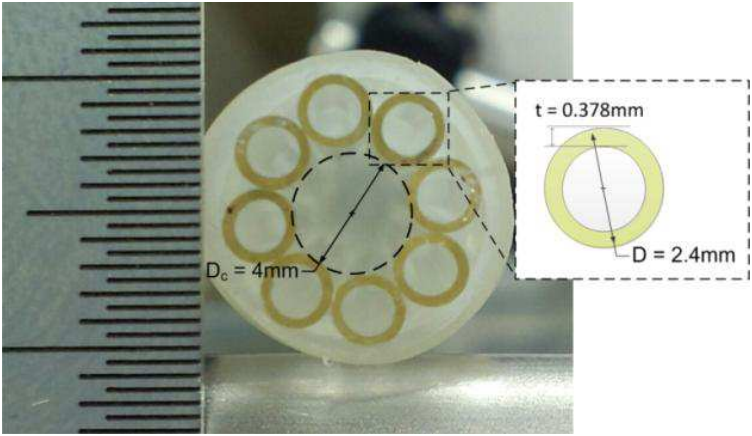
A flexible tube-lattice fiber is introduced into a THz-TDS system to implement
a THz false-color imaging system. The fiber, which has three low-loss transmission windows in
the frequency range of 0.1–1 THz, can lead THz radiation out of the system and lead back to
the detector. It can be used as a probe to break the spatial limit of the THz-TDS system and
widen the range of applications. A cuvette filled with two different kinds of white powder was
used as a sample in the experiment. One end of the fiber was fixed and the other end near the
sample was scanned by a 2D translation stage across the sample. THz radiation from the fiber
passes through the sample and is reflected by amirror at the back of the cuvette. The reflected
THz radiation contains the sample’s THz spectral information. Thus, the entire sample can be
investigated by scanning the fiber. Three-primary colors (red, green and blue) are defined by
spectral intensities of the fiber transmission windows. A 13 × 16 pixels false-color image was
generated with the mix of values of the primary colors. In the false-color image,the two kinds of
powder, the cuvette and the background present different colors and saturation which indicate
different materials and the concentration, respectively. The resolution was also investigated by
scanning slits in a metal sheet. The resolution of the imaging system is approximately 1 mm.
Citation
Alexander Argyros,
Shuqin Lou,
Wenliang Lu,
and
Xin Wang,
"THz False-color Imaging with Flexible Tube-lattice Fiber Probe," Proceedings of 2015 Photonics & Electromagnetics Research Symposium, Prague, July 6 - 9,Page(s)400-402