PhotonIcs and Electromagnetics Research Symposium,
also known as Progress In Electromagnetics Research Symposium
PIERS Proceedings
Published: 2015-07-09
Analysis of Matching Media Effect on Microwave Brain Stroke Imaging via a Spherically Symmetrical Head Model
By
Proceedings of 2015 Photonics & Electromagnetics Research Symposium, Prague, July 6 - 9,Page(s)452-456
Abstract
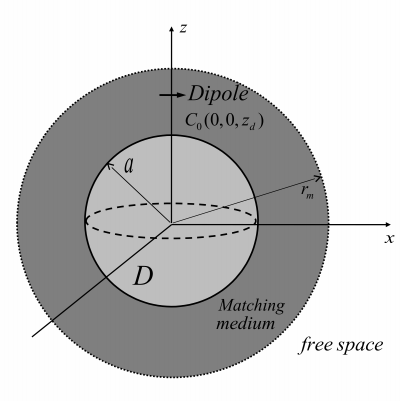
The effect of using a matching medium in the brain imaging via the microwave tomography technique has been investigated using a three-dimensional multi-layered sphere as a head model. By modelling the human head as a spherically symmetrical piecewise homogeneous sphere, the related scattering problem can be transformed into a one-dimensional form. As a result, the computational complexity of the problem can be significantly reduced. This scatter- ing problem is then solved via the discretization of the one-dimensional integral equations, and through the dyadic Green’s function related to the layered spherical structures. In order to test the effect of the matching medium for the brain stroke detection, the scattered electric fields for the healthy brain model and the stroke-affected one have been compared. The results show that in the absence of a matching medium the variation in the scattered field between two cases is too small to enable a successful stroke detection mechanism based on microwave imaging. On the other hand, in the presence of the matching medium, a noticeable difference in the scattered field has been observed. However, further tests employing more realistic models must be used to evaluate the applicability of the microwave tomography in the brain stroke detection.
Citation
Ibrahim Akduman, Ayca Aygun, Egemen Bilgin, and Ali Yapar, "Analysis of Matching Media Effect on Microwave Brain Stroke Imaging via a Spherically Symmetrical Head Model," Proceedings of 2015 Photonics & Electromagnetics Research Symposium, Prague, July 6 - 9,Page(s)452-456
References

1. Scapaticci, Rosa, Loreto Di Donato, Ilaria Catapano, and Lorenzo Crocco, "A FEASIBILITY STUDY ON MICROWAVE IMAGING FOR BRAIN STROKE MONITORING," Progress In Electromagnetics Research B, Vol. 40, 305–324, 2012.
doi:10.2528/pierb12022006        Google Scholar

2. Semenov, Serguei Y. and Douglas R. Corfield, "Microwave Tomography for Brain Imaging: Feasibility Assessment for Stroke Detection," International Journal of Antennas and Propagation, Vol. 2008, No. 1, January 2008.
doi:10.1155/2008/254830        Google Scholar

3. Fhager, Andreas and Mikael Persson, "Stroke detection and diagnosis with a microwave helmet," 2012 6th European Conference on Antennas and Propagation (EUCAP), 1796–1798, March 2012.
doi:10.1109/eucap.2012.6206715        Google Scholar

4. Meaney, P. M., S. A. Pendergrass, M. W. Fanning, and K. D. Paulsen, "IMPORTANCE OF USING A REDUCED CONTRAST COUPLING MEDIUM IN 2D MICROWAVE BREAST IMAGING," Journal of Electromagnetic Waves and Applications, Vol. 17, No. 2, 333–355, January 2003.
doi:10.1163/156939303322235851        Google Scholar

5. Bilgin, Egemen and Ali Yapar, "Electromagnetic Scattering by Radially Inhomogeneous Dielectric Spheres," IEEE Transactions on Antennas and Propagation, Vol. 63, No. 6, 2677–2685, June 2015.
doi:10.1109/tap.2015.2415856        Google Scholar

6. Li, Le-Wei, Pang-Shyan Kooi, Mook-Seng Leong, and Tat-Soon Yee, "Electromagnetic dyadic Green’s function in spherically multilayered media," IEEE Transactions on Microwave Theory and Techniques, Vol. 42, No. 12, 2302–2310, 1994.
doi:10.1109/22.339756        Google Scholar