PhotonIcs and Electromagnetics Research Symposium,
also known as Progress In Electromagnetics Research Symposium
PIERS Proceedings
Published: 2015-07-09
An Investigation of Equatorial Ionospheric Irregularities under Solar Maximum in the 24th Solar Cycle in Middle and East Africa Using GPS
By
Proceedings of 2015 Photonics & Electromagnetics Research Symposium, Prague, July 6 - 9,Page(s)157-161
Abstract
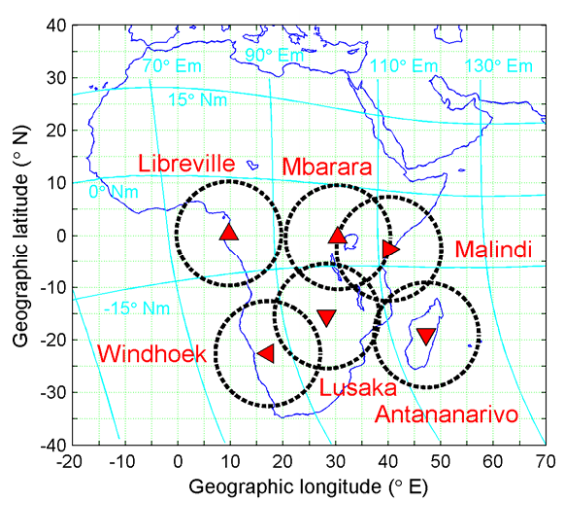
Ionospheric irregularities exert scintillations on electromagnetic waves when the waves pass through them. So they are interesting for satellite signal propagation in the iono- sphere at the magnetic equator and low latitudes. The global navigation satellite system (GNSS) observations recorded at ground-based tracking sites have been a convenient database for inves- tigating ionospheric irregularities. The irregularities over Africa during solar maximum years of 2013–2014 in the 24th solar cycle were investigated in this study by employing the Global Positioning System (GPS), which is a GNSS system. Six African GPS tracking sites of the In- ternational GNSS Service (IGS) network were adopted. First three sites were located at low latitudes close to the geomagnetic equator, in Middle and East Africa (from the Atlantic coast to the Indian coast). The other three were located at middle latitudes and at about the same longitudes as the aforementioned low-latitude sites. Equatorial irregularities were characterized by hourly GPS phase-fluctuation index. This index categorized irregularities into three levels: they are background, moderate, and strong irregularities. The important climatological results have been obtained as followings. First: The equinoctial irregularity occurrence rates over the three low-latitude sites decreased slowly from Middle to East Africa (94%, 89%, 83% and 87%, 73%, 64% for moderate and strong irregularities, respectively). Likewise, the June solstitial rates were also decreased similarly (90%, 88%, 74% and 67%, 58%, 37%). However, the December solstitial rates decreased faster (55%, 24%, 28% and 26%, 10%, 7%). Thus, the equinoctial and June solstitial occurrence rates were also high in East Africa (83% and 64%; 74% and 37%), while the December solstitial one was low (only 28% and 7%). Second: Although moderate and strong irregularities occurred very frequently over the low latitude sites (e.g., 94% and 87%), they over the three middle latitude sites all were nearly at the background level (i.e., nearly 0% and 0%). This indicates the irregularities did indeed come from the equator. Third: Although the equinoctial irregularities were dominant, the June solstitial irregularities also occurred fre- quently and their occurrence rates were comparable to the equinoctial ones, especially in Middle Africa. As for the December solstitial irregularities, they were obviously of minor importance when compared to both the equinoctial and June solstitial ones. The prominent June solstitial rates in Middle Africa may be due to the northward shifted geomagnetic equator (located in the northern hemisphere) and small declination angles.
Citation
Wei-Sheng Chen, Fang-Dar Chu, and Chien-Chih Lee, "An Investigation of Equatorial Ionospheric Irregularities under Solar Maximum in the 24th Solar Cycle in Middle and East Africa Using GPS," Proceedings of 2015 Photonics & Electromagnetics Research Symposium, Prague, July 6 - 9,Page(s)157-161
References

1. Yeh, Kung Chie and Chao-Han Liu, "Radio wave scintillations in the ionosphere," Proceedings of the IEEE, Vol. 70, No. 4, 324–360, 1982.
doi:10.1109/proc.1982.12313        Google Scholar

2..

3. Chen, W. S., C. C. Lee, J. Y. Liu, F. D. Chu, and B. W. Reinisch, "Digisonde spread <i>F</i> and GPS phase fluctuations in the equatorial ionosphere during solar maximum," Journal of Geophysical Research: Space Physics, Vol. 111, No. A12, December 2006.
doi:10.1029/2006ja011688        Google Scholar

4. Su, S.‐Y., C. H. Liu, H. H. Ho, and C. K. Chao, "Distribution characteristics of topside ionospheric density irregularities: Equatorial versus midlatitude regions," Journal of Geophysical Research: Space Physics, Vol. 111, No. A6, June 2006.
doi:10.1029/2005ja011330        Google Scholar

5. Portillo, A., M. Herraiz, S.M. Radicella, and L. Ciraolo, "Equatorial plasma bubbles studied using African slant total electron content observations," Journal of Atmospheric and Solar-Terrestrial Physics, Vol. 70, No. 6, 907–917, April 2008.
doi:10.1016/j.jastp.2007.05.019        Google Scholar

6. Aarons, J., M. Mendillo, R. Yantosca, and E. Kudeki, "GPS phase fluctuations in the equatorial region during the MISETA 1994 campaign," Journal of Geophysical Research: Space Physics, Vol. 101, No. A12, 26851–26862, December 1996.
doi:10.1029/96ja00981        Google Scholar

7. Mendillo, Michael, Bosheng Lin, and Jules Aarons, "The application of GPS observations to equatorial aeronomy," Radio Science, Vol. 35, No. 3, 885–904, May 2000.
doi:10.1029/1999rs002208        Google Scholar

8. Tiwari, R., H.J. Strangeways, S. Tiwari, and A. Ahmed, "Investigation of ionospheric irregularities and scintillation using TEC at high latitude," Advances in Space Research, Vol. 52, No. 6, 1111–1124, September 2013.
doi:10.1016/j.asr.2013.06.010        Google Scholar

9. Tsunoda, Ronald T., "Control of the seasonal and longitudinal occurrence of equatorial scintillations by the longitudinal gradient in integrated <i>E</i> region Pedersen conductivity," Journal of Geophysical Research: Space Physics, Vol. 90, No. A1, 447–456, January 1985.
doi:10.1029/ja090ia01p00447        Google Scholar

10. Tsunoda, Roland T., "On seeding equatorial spread <i>F</i> during solstices," Geophysical Research Letters, Vol. 37, No. 5, March 2010.
doi:10.1029/2010gl042576        Google Scholar

11..

12..