PhotonIcs and Electromagnetics Research Symposium,
also known as Progress In Electromagnetics Research Symposium
PIERS Proceedings
Published: 2015-07-09
Impact of Protection to Converged Access Networks Planning in Rural Areas
By
Proceedings of 2015 Photonics & Electromagnetics Research Symposium, Prague, July 6 - 9,Page(s)408-412
Abstract
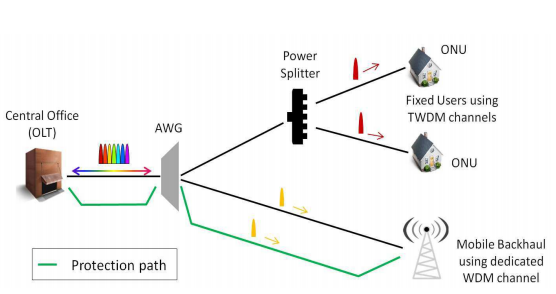
Network operators are reluctant to offer broadband access in rural areas due to the high investments and limited revenues. Protection in those areas is even more unfeasible and hence, it has not been considered by operators yet. One alternative to decrease costs when offering high bitrates in rural areas is the use of new architectures such as Hybrid Passive Optical Network (HPON). These architectures offer several advantages not only from the longer reach and higher client count, but for the possibility of offering different bandwidth per end point. The recently proposed HPON architecture could be used to offer higher bandwidth to the connected Base Stations (BS) (e.g., 10 Gbps) than the bandwidth delivered to residential users (300–500 Mbps). Recent work has presented a detailed framework using real building and street data distibution provided by OpenStreetMap, which allows computing a practical fiber layout for different access architectures and splitting ratios. This approach aims at minimizing the duct length, since costs associated to ducts and trenching have been shown to be cost drivers in access deployment. This framework has been now applied in rural areas to compare the infrastructure required for a disjoint versus a joint planning. Savings depend on the building density, area size and the inter BS distance. The contribution of this paper is focused on the analysis of the cost impact of BS protection. The required availability is obtained when protection of feeder fiber and distribution fiber is guaranteed. The investment and extra fiber and duct infrastructure required for two protection schemes are compared with the unprotected scenario. The cost increase is shown to be relatively low compared with the unprotected solution.
Citation
Carmen Mas Machuca, and Ana Munoz Diaz, "Impact of Protection to Converged Access Networks Planning in Rural Areas," Proceedings of 2015 Photonics & Electromagnetics Research Symposium, Prague, July 6 - 9,Page(s)408-412
References

1. ITU, "ICT facts and figures: The World in 2014", 2014.        Google Scholar

2. Wosinska, Lena, Jiajia Chen, Carmen Mas Machuca, and Miroslaw Kantor, "Impact of protection mechanisms on cost in PONs," 2009 11th International Conference on Transparent Optical Networks, 1–4, June 2009.
doi:10.1109/icton.2009.5185112        Google Scholar

3. Reyes, Ronald, Rong Zhao, and Carmen Mas Machuca, "Advanced dynamic migration planning toward FTTH," IEEE Communications Magazine, Vol. 52, No. 1, 77–83, January 2014.
doi:10.1109/mcom.2014.6710067        Google Scholar

4. Munoz Diaz, Ana and Carmen Mas Machuca, "Are converged access networks suitable in rural areas?," 2015 17th International Conference on Transparent Optical Networks (ICTON), 1–4, July 2015.
doi:10.1109/icton.2015.7193629        Google Scholar

5. Machuca, C. M. and B. Topalogu, "Impact of protection strategies on the cost of Next Generation Hybrid PON access networks," Proceedings of 9th International Conference on the Design of Reliable Communication Networks (DRCN), Budapest, Hungary, March 2013.        Google Scholar

6. Mahloo, Mozhgan, Jiajia Chen, Lena Wosinska, Abhishek Dixit, Bart Lannoo, Didier Colle, and Carmen Mas Machuca, "Toward reliable hybrid WDM/TDM passive optical networks," IEEE Communications Magazine, Vol. 52, No. 2, S14–S23, February 2014.
doi:10.1109/mcom.2014.6736740        Google Scholar