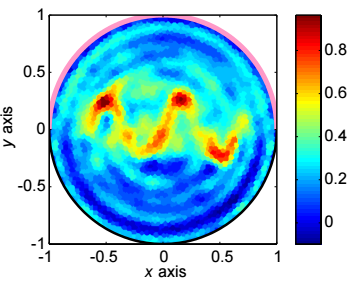
1. Ahn, Chi Young, Kiwan Jeon, Yong-Ki Ma, and Won-Kwang Park, "A study on the topological derivative-based imaging of thin electromagnetic inhomogeneities in limited-aperture problems," IOP Publishing, Vol. 30, No. 10, 105004, September 2014.
doi:10.1088/0266-5611/30/10/105004 Google Scholar
2. Álvarez, Diego, Oliver Dorn, Natalia Irishina, and Miguel Moscoso, "Crack reconstruction using a level-set strategy," Elsevier BV, Vol. 228, No. 16, 5710–5721, September 2009.
doi:10.1016/j.jcp.2009.04.038 Google Scholar
3. Ammari, Habib, Josselin Garnier, Vincent Jugnon, and Hyeonbae Kang, "Stability and Resolution Analysis for a Topological Derivative Based Imaging Functional," Society for Industrial & Applied Mathematics (SIAM), Vol. 50, No. 1, 48–76, January 2012.
doi:10.1137/100812501 Google Scholar
4. Ammari, Habib, Hyeonbae Kang, Hyundae Lee, and Won-Kwang Park, "Asymptotic Imaging of Perfectly Conducting Cracks," Society for Industrial & Applied Mathematics (SIAM), Vol. 32, No. 2, 894–922, January 2010.
doi:10.1137/090749013 Google Scholar
5. Bonnet, Marc, Bojan B. Guzina, and Nicolas Nemitz, "Fast non-iterative methods for defect identification," River Publishers, Vol. 17, 571–582, June 2008.
doi:10.13052/remn.17.571-582 Google Scholar
6. Carpio, A and M-L Rapún, "Solving inhomogeneous inverse problems by topological derivative methods," IOP Publishing, Vol. 24, No. 4, 045014, July 2008.
doi:10.1088/0266-5611/24/4/045014 Google Scholar
7. Dorn, Oliver and Dominique Lesselier, "Level set methods for inverse scattering," IOP Publishing, Vol. 22, No. 4, R67–R131, June 2006.
doi:10.1088/0266-5611/22/4/r01 Google Scholar
8. Eschenauer, H. A., V. V. Kobelev, and A. Schumacher, "Bubble method for topology and shape optimization of structures," Springer Science and Business Media LLC, Vol. 8, No. 1, 42–51, August 1994.
doi:10.1007/bf01742933 Google Scholar
9. Feijoo, Gonzalo R and G. R., "A new method in inverse scattering based on the topological derivative," IOP Publishing, Vol. 20, No. 6, 1819–1840, September 2004.
doi:10.1088/0266-5611/20/6/008 Google Scholar
10. Park, Won-Kwang, "Multi-frequency subspace migration for imaging of perfectly conducting, arc-like cracks in full- and limited-view inverse scattering problems," Elsevier BV, Vol. 283, 52–80, February 2015.
doi:10.1016/j.jcp.2014.11.036 Google Scholar
11. Park, Won-Kwang, "Multi-frequency topological derivative for approximate shape acquisition of curve-like thin electromagnetic inhomogeneities," Elsevier BV, Vol. 404, No. 2, 501–518, August 2013.
doi:10.1016/j.jmaa.2013.03.040 Google Scholar
12. Park, Won-Kwang, "Shape Reconstruction of Thin Electromagnetic Inclusions via Boundary Measurements: Level-Set Method Combined with the Topological Derivative," Wiley, Vol. 2013, 1–7, 2013.
doi:10.1155/2013/125909 Google Scholar
13. Park, Won-Kwang, "Topological derivative strategy for one-step iteration imaging of arbitrary shaped thin, curve-like electromagnetic inclusions," Elsevier BV, Vol. 231, No. 4, 1426–1439, February 2012.
doi:10.1016/j.jcp.2011.10.014 Google Scholar
14. Park, W.-K. and Lesselier D., "Reconstruction of thin electromagnetic inclusions by a level set method," Inverse Problems, Vol. 25, 2009.
doi:10.1007/978-3-642-13624-5_11 Google Scholar
15. Sokolowski, Jan and Antoni Zochowski, "On the topological derivative in shape optimization," SIAM J. Control Optim., Vol. 37, 1251–1272, 1999. Google Scholar
 Suzhou2026